The Wellspring Collaborative formed in 2011 as an informal network and with support from the University of Massachusetts, Creative Economy Grant
Wellspring’s mission is to create an economy that is cooperative, equitable, democratic, and sustainable. We work with historically under-served communities in the Greater Springfield region by developing a network of worker cooperatives and by supporting community-led initiatives to cultivate cooperatives and collective well-being.
The seeds of Wellspring Cooperative emerged from discussions between Emily Kawano, drawing on her work as Coordinator of the US Solidarity Economy Network, and Director of the Center for Popular Economics, and Fred Rose, growing out of his experience as Lead Organizer of the Pioneer Valley Project in Springfield. They convened local community leaders who were interested in finding more cooperative and sustainable strategies to address the lack of job opportunities for Springfield city residents and implement community wealth-building opportunities.
A key inspiration was the Evergreen Cooperatives model in Cleveland that had gained national attention for leveraging the purchasing power of anchor institutions– institutions that are grounded in the community such as hospitals and universities– to create a dependable source of income for large-scale cooperatives.
Springfield, like Cleveland, is an older industrial city whose largest employers are now the region’s non-profit hospitals, colleges, and universities that anchor the regional economy. In line with the Evergreen Cooperatives’ Cleveland Model, Wellspring Cooperative developed formal partnerships with anchor institutions and researched viable cooperatives that would satisfy their outsourcing needs, as well as needs of the community.
Another key inspiration was the Mondragon cooperatives in the Basque region of Spain which is the largest cooperative economy in the world. While Mondragon grew out of economic isolation in Franco’s Spain, perhaps anchor institutions could provide the scale of committed purchasing power needed to build a cooperative economy in America.
Wellspring Cooperative’s first worker-owned business, Wellspring Upholstery opened its doors in December 2013 in Springfield with an initial contract from Berkshire Dining Hall at the University of Massachusetts. Wellspring continued to investigate and grow cooperatives from this approach including Old Window Workshop and Wellspring Harvest.
While Wellspring was initially focused on developing worker cooperatives through its own business plans, the focus has not been shifted to prioritize technical assistance for groups forming their own co-ops. This shift reflects the desire to support the ideas that come directly from community members. Over four cooperative businesses have joined the Wellspring network this way including Farm Bug, Chronic Trips, and Catalyst Cooperative Healing.
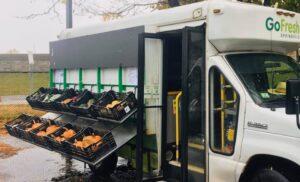
Another major evolution Wellspring has undergone was the pivot towards a holistic approach. With this in mind, Wellspring expanded its focus on community engagement through initiatives that meet immediate community needs. This led to the adoption of Go Fresh Mobile Market from the Public Health Institute of Western Massachusetts as an expansion of Wellspring Harvest’s food access mission in 2021. Community programs that complement our cooperative develop work can increase community engagement, expand people’s capacity to envision a cooperative economy, and strengthen the cooperative ecosystem.
The Wellspring Collaborative formed in 2011 as an informal network and with support from the University of Massachusetts, Creative Economy Grant


Founding group Wellspring Cooperative took a delegation to tour and learn from Evergreen Cooperatives in Cleveland, Ohio. This trip galvanized support for a similar model in Springfield, Massachusetts and left people feeling inspired for the work ahead!
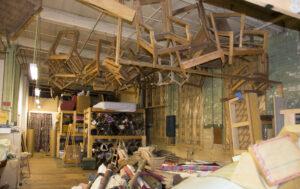
Wellspring’s first co-op, Wellspring Upholstery Cooperative, opened its doors in 2013.

Co-op Boot Camp is an annual two-part course which provides both a four-week introduction to cooperative forms of ownership, and an intensive ten-week co-op planning process for groups interested in forming their own companies. Boot Camp participants are developing new cooperative businesses in Springfield and, since the class went virtual due to the pandemic, in other areas of the country such as Illinois, Virginia, and Mississippi.
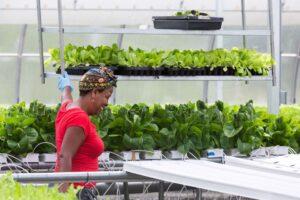
After years of work, the quarter-acre hydroponic greenhouse was completed in April 2018. Wellspring Harvest opened its doors shortly after, making it the first commercial hydroponic greenhouse in the City of Springfield. Wellspring Harvest was the second co-op Wellspring Cooperative grew using the anchor institution model.
Wellspring was certified as a community development corporation in 2018, becoming the only CDC in the state of Massachusetts dedicated to the creation of worker cooperatives.
We are founding members of the statewide Coalition for Worker Ownership and Power (CoWOP) that was formed in March 2019 with a founding statewide coop conference. Wellspring has helped to found multiple state and national cooperative collaborations that are helping to build the larger movement for a cooperative economy.

Wellspring took over the operation of the Go Fresh Mobile Market from the Public Health Institute of Western Massachusetts as an expansion of Wellspring Harvest’s food access mission in 2021. Wellspring also carried out a special donation appeal as hunger increased from the Covid pandemic to support greenhouse workers and provide fresh lettuce to the Food Bank of Western Mass and the Indian Orchard Survival Center.
In our 2021 Strategic Plan, Wellspring expanded our mission to include a key focus on cooperative community initiatives.
In ____ our organization also joined with sister community-based cooperative development organizations Co-op Cincy, Cooperation Jackson and Cooperacion Santa Ana to form a national partnership to develop childcare and other cooperatives.